










4Debutants
First-time qualifiers
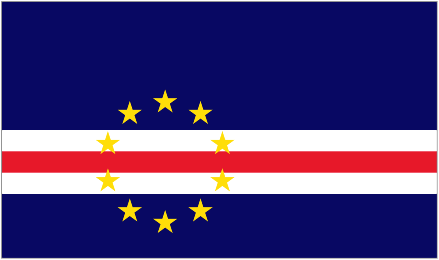
Four nations make their World Cup debut in 2026: Cape Verde, Curaçao, Jordan and Uzbekistan. Curaçao — population around 156,000 — becomes the smallest nation ever to reach a World Cup.
Argentina are favourites
Standings, qualification and predict mode for all 12 groups.
The 12 third-placed teams ranked — who's through to the Round of 32 and who's out.
All 104 fixtures with live scores in your time zone.
The new Round of 32, then R16, QF, SF and the Final.
Visual bracket — predict your champion from R32 to the Final.
Top scorers, assist leaders and tournament records.
16 cities across three countries, with capacity and climate notes.
How the 48-team format, tiebreakers and refereeing changes work.
The 2026 edition is the biggest World Cup ever — 48 teams, 12 groups, 104 matches across three host nations. Below are the most-asked questions about the new format, tiebreakers and refereeing rules, in plain English.
Four nations make their World Cup debut in 2026: Cape Verde, Curaçao, Jordan and Uzbekistan. Curaçao — population around 156,000 — becomes the smallest nation ever to reach a World Cup.
Vancouver to Mexico City is 3,940km — further than Lisbon to Moscow. Bosnia and Herzegovina drew the worst of it: around 5,000km of flights across their three group games, more than any other team at the tournament.
Mexico City sits at 2,240m, Vancouver at sea level. A team drawn into the wrong cluster of venues plays at a 2.2km altitude swing — and the matches are only 96 hours apart.
The winning squad assembles in early June and lifts the trophy on 19 July — eight matches across a 39-day tournament. Add a full club season either side, and the busiest players on the champion nation can end the calendar year with 70+ competitive games.
Monterrey, Dallas and Miami are the brutal ones — peak afternoon wet-bulb temperatures push the FIFA cooling-break threshold. Watch for tactical changes at the 30-minute mark in afternoon kickoffs.
The new Round of 32 adds an extra knockout round. The eventual champions now play eight matches in total — three group games plus five knockouts (R32, R16, QF, SF, Final) — one more than any previous World Cup winner needed.
FIFA grouped the 16 host cities into three regional clusters to limit travel during the group stage. Knowing your team's cluster tells you a lot about the climate, altitude and travel days you can expect across their first three matches.
Pacific cluster. Teams here play in mild evening conditions; the only altitude risk is the road trip to Mexico for the second match.
The hot/altitude cluster. Mexico City's 2,240m and afternoon kickoffs at the southern US venues are the dominant tactical factor.
Atlantic cluster. Coastal cities, milder temperatures than central, and the route to the Final — every East-cluster group can reach MetLife on a single short flight.